OpenClaw’s Impact
OpenClaw, an open-source AI project featuring a lobster icon, gained over 150,000 stars on GitHub early this year and has rapidly swept through the tech and finance sectors. While many still deem it immature and unreliable, eight brokerage firms have already released comprehensive application tutorials, with companies beginning to use it to replace human jobs.
True technological revolutions do not wait for universal acceptance; the seeds of division are often sown before consensus is reached. Can ordinary people really remain detached from the transformation brought about by AI Agents?

Diverging Paths in AI Adoption
Following the rise of OpenClaw, an interesting split has emerged in the industry.
On one side, experts and scholars critique the tool from the sidelines, pointing out its bugs and instability, labeling it as a risky tool. They use its perceived immaturity as a basis for their criticisms. Even when they set up the environment, they only skim the surface, quickly abandoning it upon encountering issues to validate their initial judgments.
Conversely, another group has dived right in, disregarding whether it is perfect today. The quantitative teams from eight domestic brokerages have publicly shared a complete set of tutorials covering everything from deployment to research application, detailing multi-platform configurations, quantitative backtesting, and financial report analysis.
Why does such extreme division occur over the same project? The core difference lies not in technical understanding but in the logic applied to new technologies: the former seeks problems, while the latter seeks utility.
Those who seek problems can always find a thousand reasons not to act. OpenClaw is indeed imperfect, with bugs and deployment costs, but those who seek utility focus solely on one question: What can it help me accomplish right now?
The essential difference between OpenClaw and traditional large models is that it has “hands.” Traditional models respond to queries with outputs; OpenClaw can directly operate your computer, automating the entire process from data gathering to result output.
For brokerage research personnel, who process thousands of market data points daily, organizing financial reports, searching for information, and performing conditional stock selection, these repetitive tasks can be automated by OpenClaw, effectively providing an efficiency lever. This advantage will always be lost on those standing on the sidelines.
Cost Disparity and Rapid Corporate Transformation
Many believe that AI Agents replacing human labor is still a distant prospect, merely hype in the tech sphere. However, the real data speaks for itself.
In March, collaboration tool vendor Atlassian laid off 1,600 employees, with the CEO stating that the layoffs were to reallocate budget towards AI Agents. Klarna, a European buy-now-pay-later platform, replaced over 700 customer service representatives with an AI Agent, fully handling the customer service process while meeting KPI and SLA standards.
Businesses are more astute than anyone else. The cost of performing the same work with an AI Agent is lower, more scalable, and continually decreasing, making it a financially sound decision.

Ordinary employees worry about whether this transformation will be slow. Let me break it down: with current deployment costs, an individual can use a basic setup for only $54 a month, and even a standard team configuration costs just $158. This barrier is nearly negligible. For companies, the question is no longer whether to transition, but how quickly to do so—transitioning a year earlier means reducing costs and increasing efficiency a year sooner.
Some may argue, “I’m just an ordinary employee; what does corporate transformation have to do with me?” The reality is straightforward: as businesses gradually hand over operations to Agents, employees who cannot operate or debug the Agent will inevitably have lower productivity than those who can. At that point, predicting corporate choices becomes easy.
This division did not begin on the day of layoffs; it started the first time you chose to “wait and see,” using “immaturity” as an excuse to refrain from action.
Cognitive Inertia Widening the Gap
Many hold the belief that they can wait until technology matures before learning to use it, thinking they can hop on board at any time.
Theoretically, one can indeed join at any time, but the issue lies in cognitive inertia. When you choose to stand on the side of “not using it,” your behavior reinforces that choice. You will continuously seek new arguments to justify inaction, becoming increasingly desensitized to new technologies, eventually losing the ability to understand what others are discussing.
For example, those who have consistently used OpenClaw are now discussing how to delegate tasks to AI, adjust context windows, and combine multiple skills to complete processes. Those who have never used it may not even understand the terminology.
It’s not a matter of capability; it’s that your cognitive systems have diverged—one is a new system collaborating with AI, while the other relies solely on the old system, creating a behavioral isolation between the two.
Initially, the gap may be small, perhaps saving just a few minutes each day. But the longer one uses AI, the more tasks it handles, allowing more time to explore new functionalities, gradually reconstructing the entire work process: you only need to assign tasks to AI and debug results, while most execution work is completed by AI.
Meanwhile, those on the other side may seem to save time by avoiding AI’s complexities, but they miss the optimal window for reconstructing work methods and cognitive structures. By the time they realize the shift, others’ work efficiency may have multiplied several times, making it much harder to catch up.
The True Divide of Our Era: Action, Not Ideas
I once heard a saying that the greatest unfairness of the AI era is the information gap. However, I increasingly believe that the greatest unfairness is the action gap.
Everyone can see the news about OpenClaw’s rise, everyone can freely download it, and the technology is open-source with controllable costs—no one is stopping you from using it. Yet, some choose to watch while others choose to act, leading to vastly different career competitiveness in a few years.
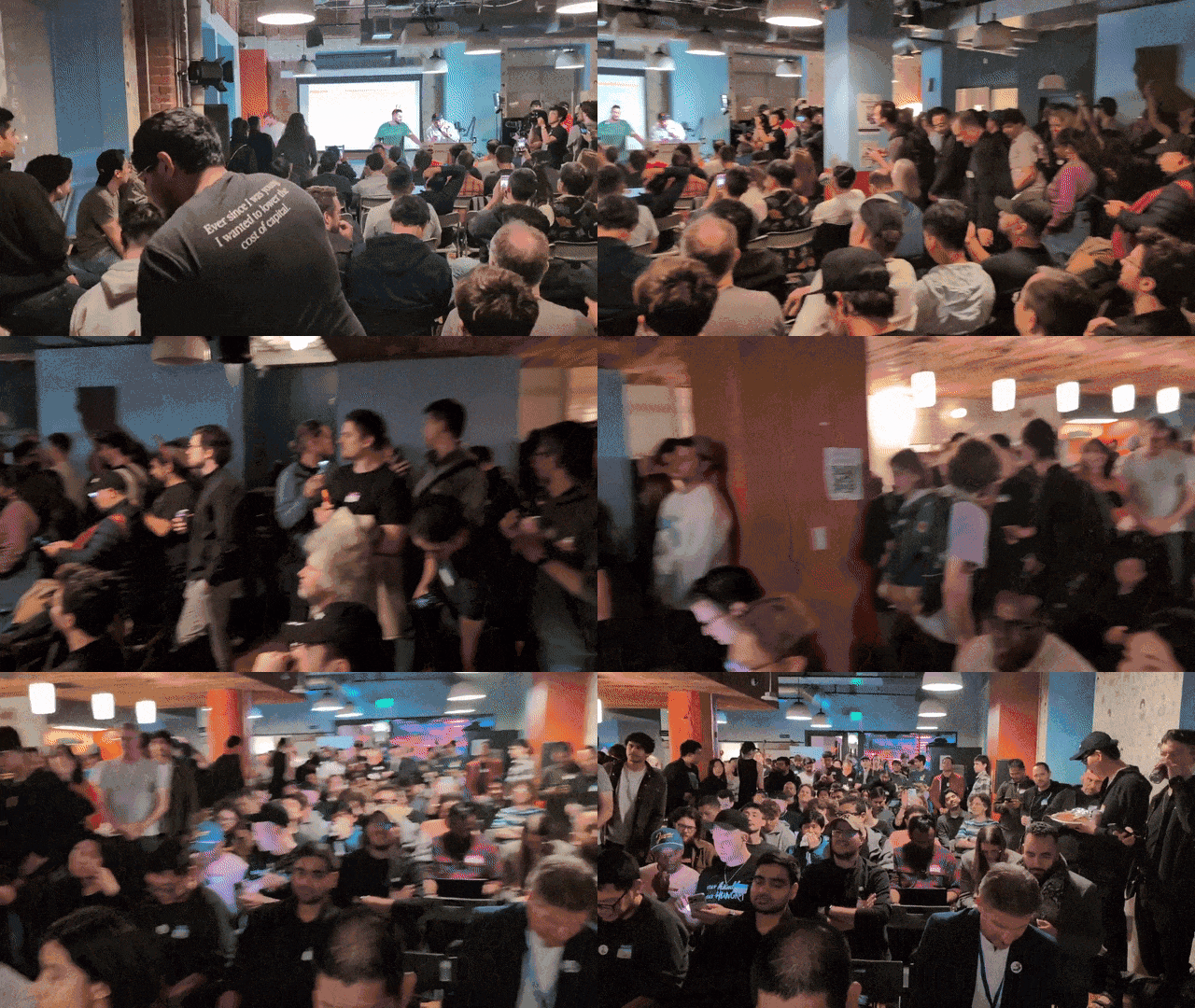
For individuals, the difficulty of getting started is truly low: even if you cannot deploy it locally, spending a few dollars on basic cloud services allows you to use it. A few dollars is merely the cost of a cup of coffee, yet it can help you access the next generation of productivity tools ahead of time.
For corporate decision-makers, the cost of rejecting AI Agents extends beyond mere employee efficiency—when the entire industry adopts Agents to reduce costs and improve efficiency, and you persist with fully manual processes, it won’t be long before your cost structure loses competitiveness, potentially leading to the entire enterprise’s elimination.
Technological revolutions are never gentle; they do not pause to wait for everyone to be ready. They automatically divide people into two groups: those who embrace change proactively and those who stand still and face obsolescence.
This era will not persuade you to change; it will educate through outcomes. The true divide has already presented itself before you; which side you choose to stand on depends solely on whether you take that first step today.
Comments
Discussion is powered by Giscus (GitHub Discussions). Add
repo,repoID,category, andcategoryIDunder[params.comments.giscus]inhugo.tomlusing the values from the Giscus setup tool.